Subtitle: Implementing an Active Peace Strategy—The World’s Premier Strategic Location in the Face of Shifting Global Economic Centers and the U.S. Vacuum in International Governance.
By Lee Won-young
Director of Land & Future Research Center (LAFUR)
Peace Is an Institution, Not a Declaration
Northeast Asia is often cited as a flashpoint for global conflict: the North Korean nuclear crisis, the US-China hegemony struggle, and the long-standing division of the Korean Peninsula. But what if the epicenter of the problem became the epicenter of the solution? Peace does not come through mere declarations; it is sustained only when interests are intertwined and institutions take root. International organizations are the physical manifestation of such systems. When organizations cluster, they create a neutral zone for dispute resolution, foster human exchange, and build global networks. It is no coincidence that Brussels became the symbol of European peace.
The Waning Era of the United Nations
The center of the global economy has come to Northeast Asia
The center of the global economy has shifted to Northeast Asia just as the demand for international governance explodes. Asia’s share, which was 30% of the world’s GDP in 2000, is about 50% as of 2025. China’s $18.3 trillion, Japan’s $4.1 trillion, and Korea’s $1.7 trillion. The three Northeast Asian countries alone account for 22% to 23% of the global economy. It is an area that drives one-quarter of the world’s economy.
But how many headquarters of international organizations are there in this area? According to the Union of International Organizations’ 2024/2025 Almanac, there are currently about 45,000 active international organizations and over 78,500 registered organizations worldwide. The number has nearly doubled from 2008. However, its headquarters are still extremely concentrated in Europe and North America. There are 1,000 in Brussels, 288 in Paris, 284 in London, 156 in Vienna, and 135 in Geneva. Singapore is the largest in Asia with 111, 92 in Tokyo, and 76 in Seoul. The three largest cities in Northeast Asia combined accounted for just 210 — one fifth of Brussels alone.
There is such a wide gap between the share of the global economy and that of international organizations. This is an imbalance. And imbalances always require adjustment.
The “Trump Gap”: A Historic Opportunity
In January 2026, the Trump administration announced its withdrawal and cessation of funding for 66 international organizations, including key bodies like the UNFCCC (Climate Change), IPCC, and UNCTAD. This “historic vacuum” is ironically an opportunity. Organizations fleeing the U.S. need new hubs. This is the moment to reconsider new foundations, relocations, and expansions.
The Han River Estuary: A Site Without Equal
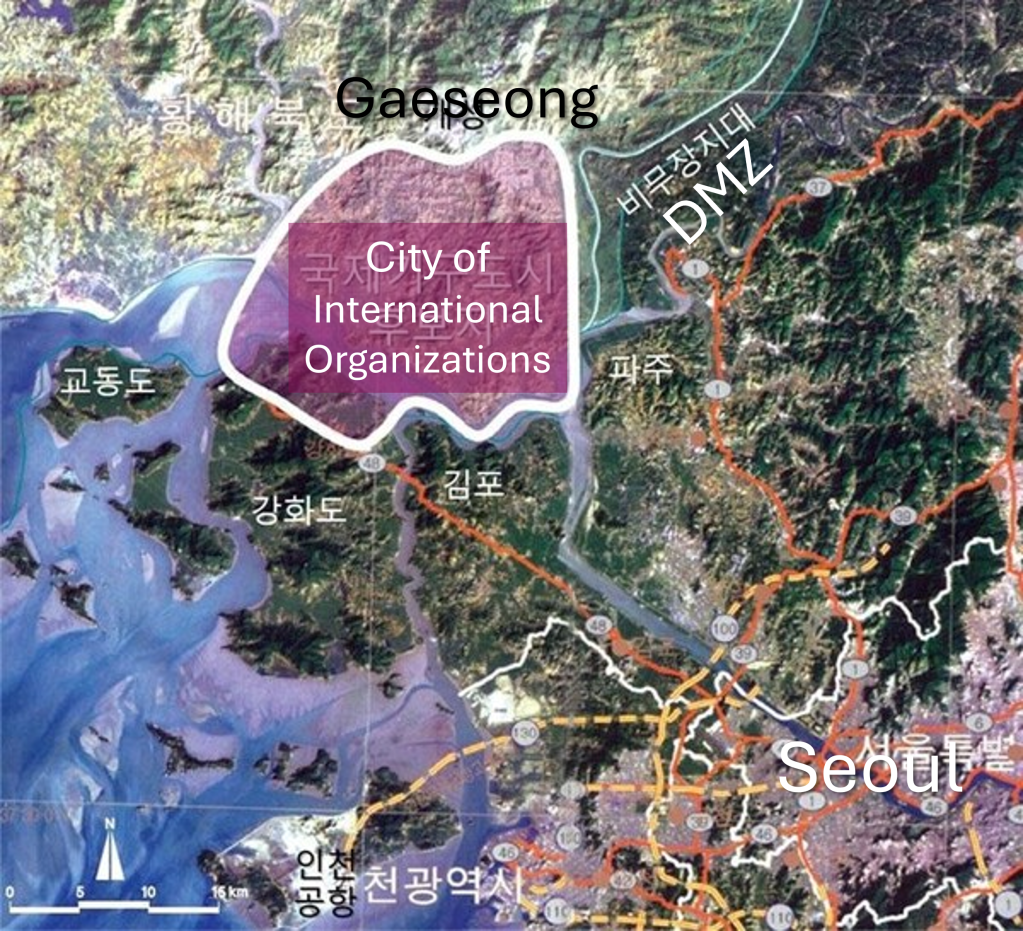
Where should this new hub be? I propose the Han River Estuary. Spanning approximately 260 $km^2$ and centered around Kaepung, the Kaesong Industrial Complex, and northern Ganghwa Island, this area remains untouched for 70 years due to the division. Its potential is unparalleled. It is within 1 hour of Incheon International Airport and 2 hours from Beijing, Shanghai, and Tokyo. It is the only point on Earth where the sea and the Eurasian Continental Railway can simultaneously connect.
In this “International Organization City,” bodies governing climate, energy transition, data sovereignty, and maritime resources will take root. Their presence itself becomes a physical guarantee of peace. To encroach upon the Han River Estuary would be to challenge the dozens of nations represented within those organizations. This is the “Brussels of Northeast Asia.”
A Viable Exit Strategy for North Korea
This proposal offers North Korea a realistic path to connect with the world without regime change. Based on a “lease model,” North Korea would retain land ownership while receiving land rent to benefit its citizens—a model already proven on a smaller scale by the Kaesong Industrial Complex. International organizations would bring infrastructure and global safety guarantees, replacing the stability born of isolation with the stability born of connectivity.
When Imagination Becomes Strategy
The abolition of slavery, women’s suffrage, and the formation of the European Union were once dismissed as fantasies. History is a record of the impossible becoming inevitable. The UN is aging, and the demand for new global governance is peaking. The geopolitical weight of the Korean Peninsula should not be a burden, but an asset. Turning the border of division into a hub of human cooperation—this is the essence of an active peace strategy.
The time is now. We must build, relocate, and expand. The Han River Estuary is the answer.
Categories: Uncategorized


Leave a Reply