Two Years of Japanese Nuclear Waste Dumping… A Warning from the Sea
Omens that cannot be overlooked… Stop right now!
Incident 1
On April 10, 2015, an incident occurred in which 150 dolphins were stranded on the shore off Hokota City, Ibaraki Prefecture, Japan. This beach is about 150 km south of the Fukushima Nuclear Power Plant. The incident drew great attention at the time, and there was much speculation about the cause of the deaths. However, no official explanation has been provided to this day.
Hirose Takashi, a prominent Japanese writer and nuclear expert, explained that radiation exposure can cause various diseases including myocardial infarction. He stated that radiation can damage all cells and organs of the body, not only cause cancer, and can trigger diseases such as myocardial infarction, particularly affecting the heart and blood vessels. In other words, the lungs of dolphins, which breathe similarly to humans, appeared white due to myocardial infarction—a typical result of radioactive contamination.
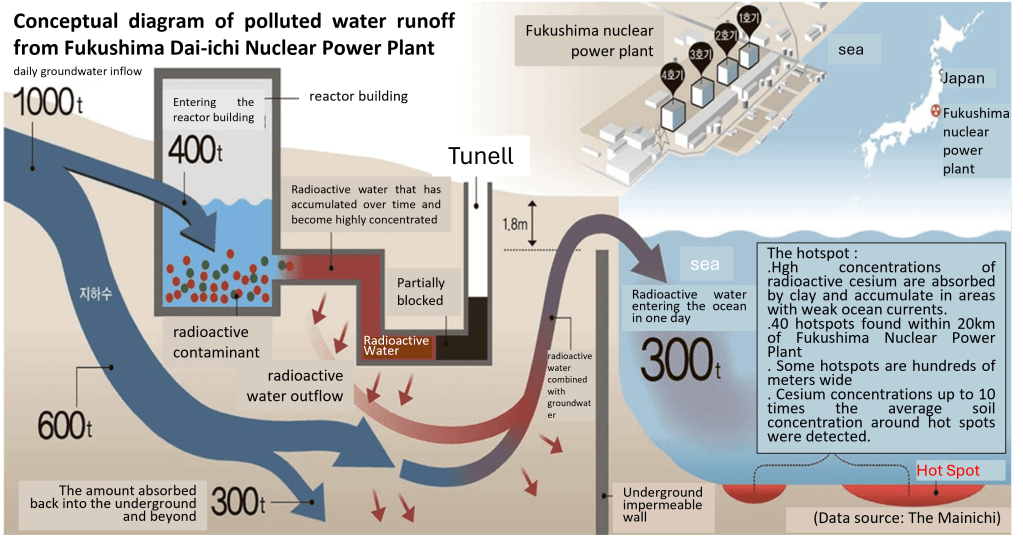
In fact, 300 tons of nuclear wastewater per day were discharged into the sea immediately after the Fukushima nuclear accident. A 2013 survey by the University of Tokyo reported the presence of hot spots around the area. A hot spot is a location where a high concentration of radioactive cesium becomes adsorbed onto clay and accumulates in hollows where seawater flow is blocked. Such places were found in 40 locations within the 20 km zone of the Fukushima Nuclear Power Plant, with some measuring several hundred meters in diameter. Cesium was detected there at up to 10 times the average concentration found in surrounding soil. No further announcements have been made since then.
Considering the amount released over the past 14 years, it is impossible to know how many hotspots now exist in Japan’s coastal waters. While radiation dissolves in seawater, it can also flow along ocean currents without fully dispersing. The deaths of the dolphins remain a shocking warning to us.
Incident 2
In October 2023, several unexplained tsunamis were observed in Japan, raising concern in academic circles. These tsunamis were divided into two groups according to their location: one in the southwestern part of the Japanese archipelago and the other south of the Fukushima nuclear power plant. For example, a tsunami about 70 cm high was observed in Hachijojima in the latter case.
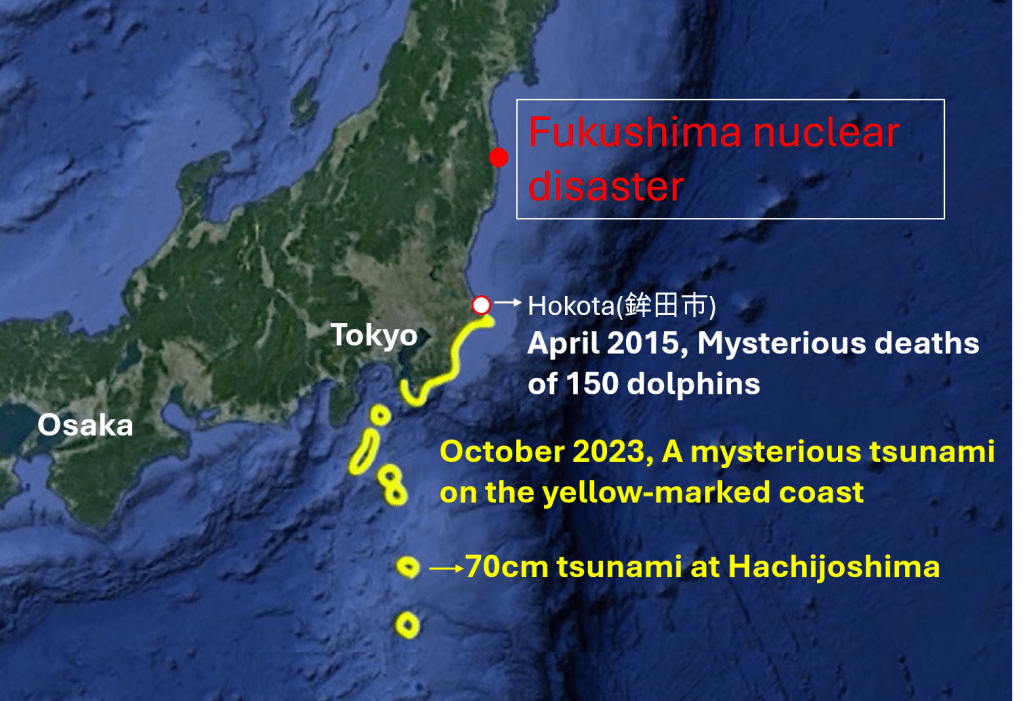
When mapping these two events together, they appear closely related to the Fukushima nuclear plant. It raises the question of whether radioactivity released from the plant could be triggering incidents further south along the currents.
What is happening at the hotspots, where radioactive particles sink and accumulate in ocean currents? Could radiation penetrate the strata and kill off microbes?
A research paper sheds light on this. In April 2023, before the Japanese government released nuclear wastewater, Chinese scientists published a paper in the international journal Environmental Science &Technology titled “The Impact of Tritium and Carbon-14 Radiation Pollution on Marine Microbes.” Their findings showed that in seawater and seabed sediment samples exposed to high concentrations of tritium and carbon-14, there was a decrease in the number of specific microbial species and a shift toward radiation-resistant species becoming dominant. They confirmed that radionuclides affect the gene expression of microorganisms and reduce metabolic functions related to elemental cycles such as carbon, nitrogen, and sulfur. In short, radiation has deadly effects on microorganisms.
The problem is that when microorganisms die or lose their functions, the tensile strength within the soil weakens. This is a serious issue. In civil engineering, for example, soil stabilization often relies on the tensile strength provided by microorganisms. The importance of microbial tensile strength is recognized to the extent that it is used as a construction method. This can be seen in rice paddies: when herbicides are applied, plant roots weaken, microorganisms that bind the soil also die, and the paddies collapse.
If this happens in the ocean, the risk is far greater than on land—because of the enormous water pressure. The strata that must withstand this pressure may develop cracks or collapses due to weakened soil cohesion, which could lead to major disasters. Thus, the release of nuclear wastewater carries not only the risk of contamination and destruction of the food chain but also the risk of earthquakes and tsunamis.
A large amount of nuclear waste has already been dumped into the sea since the accident. Even though alternative methods exist, we are abandoning responsibility. Of course, nuclear power plants around the world inevitably leak small amounts of cooling water during operation. But it is precisely because of such dangers that humanity has been working toward energy transition and denuclearization.
However, the recent actions of the Japanese government are of a different nature. They pose a serious and fundamental challenge to humanity. Even though other options exist, Japan has chosen a harmful path. By doing so, the Japanese government is setting a dangerous precedent for the entire world.
Yesterday, August 24, marked the second anniversary of the Fukushima nuclear wastewater discharge. As one astronaut once said, “We are not passengers on Earth—we are crew members.”
There are many creatures aboard this spaceship called Earth alongside humans. We have no right to harm them. If advanced countries that lead the world set such false examples, others will follow in indulging similar evils. At this rate, there is no hope for humanity. This must be stopped immediately.
Translated by JEW mee,
Written by LEE Won-Young
Original Article: https://www.mindlenews.com/news/articleView.html?idxno=15272
일본 핵폐수 투기 2년…바닷속에서 보내오는 경고음 < 민들레 들판 < 기사본문 – 세상을 바꾸는 시민언론 민들레
Categories: Uncategorized


Leave a comment