Gangneung area has suffered from frequent climate disasters including typhoon, big forest fire and a heavy snowfall for recent 20 years. The East Coast, because of the geological characteristic of the main range of Mt, Baekdu(Baekdudaegan) and the East Sea, has Foehn phenomenon. This Foehn phenomenon causes the land dried fast after rain. In addition, its steep slope has water in store difficult. The Yanggangjipung(dry, strong wind moving between Yangyang and Gangneung) is also diagnosed as the cause of big forest fire.
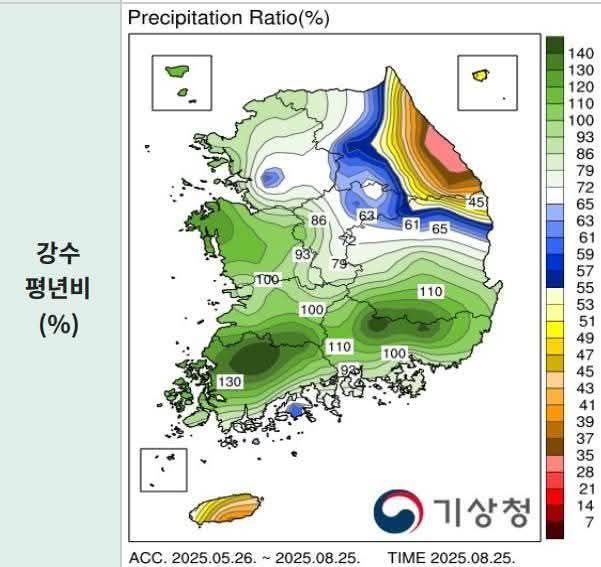
Figure 1. Rainfall from May to August of this year: Precipitation near Gangneung shows less than 35% of the annual average.
In addition, the move of ocean current around the Korean peninsula is also one of the reasons. The followings is the model picture known by oceanographers

Figure 2. A schematic diagram of ocean currents around the Korean Peninsula. Yonhap News
The recent reported data measuring temperature of the ocean arouses much interest. Among the theses published last year, there is an analysis based on the data of ocean temperature measured by an artificial satellite. Also the map of ocean temperature measured in April, 2023(picture 3) attracts my attention.
According to this map, the ocean current is flowing in accordance with the movement of East Korea Warm Current. This East Korea Warm Current separated from Tsushima Warm Current, moving north, goes via atomic power plants in Busan, Ulsan and Uljin, through Gangneung, meeting the North Korea Cold Current, and turns sharply to the Ulleungdo.
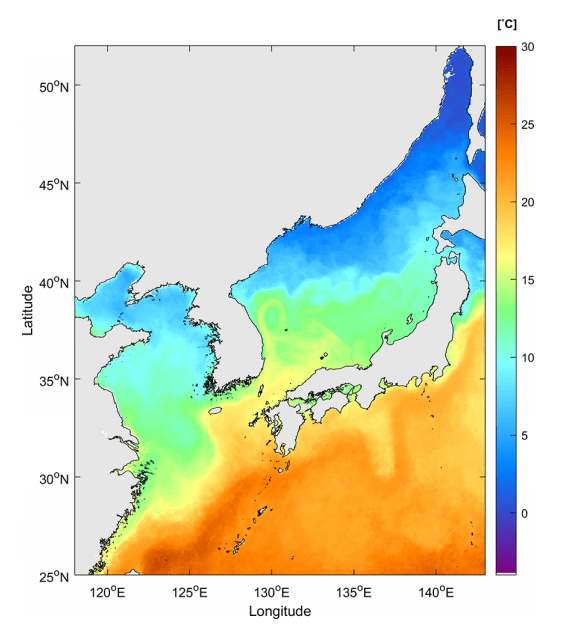
Figure 3. Satellite-observed water temperature in the waters of the Korean Peninsula (April 2023) (Lim Chae-young et al. 5 people, Sentinel-3 A/BSLSTR stratum sea surface temperature verification in coastal waters of the Korean Peninsula, re-applied by the Korea Geoscience Society, October 2024 issue)

Figure 4. The enlarged part of the East Coast area on the above map.
The turning sea is deep. The thesis explains the process of measuring the temperature that is observed by satellite in the real sea. In this surveyed map is shown the information of depth of the sea.
This map shows that East Korea Warm Current is flowing on the surface of deep sea. The deeper the sea is, the more amount of water has the sea. The area named Ulleung valley in the sea is rich in comparatively low temperature water. It is analogized that East Korea Warm Current is moving on its surface.

Figure 5. The water temperature measurement location is indicated on the water depth map of the Korean Peninsula (quoted in the above paper).
The problem is the situation that the sea becomes warmer and warmer because the hot water from nuclear power plant is added to the original warm current of that area. The nuclear power plant needs a plenty of water to cool down the heat produced by nuclear fission. Two-thirds of that generated heat is thrown into the sea as hot waste water, and only a third is used in producing the electricity. Nuclear power plant(1000kw) warms down the water to 7 C using seawater from 70 to 100 ton per a second as cooling water and let it go out to the sea. Because of this hot waste water nuclear power plant can be seen as a heating system of seawater.
The number of nuclear power plants in operation in the East coast now is 18: 7 in Busan Gori, 5 in Gyeongju Wolseong, 6 in Uljin. From these plants does come forth ceaselessly 1800 ton at its maximum per a second. Thus the total amount of hot waste water discharged for a year is 56 billion ton. Compared with the annual amount of inflowing water of Nakdong river, 11 billion ton, we can see how tremendous amount of hot waste water is discharged.
The warm water, spreading out widely on the surface of sea, blows off the heat but also maximizes the emitting of carbon dioxide. If such a tremendous amount of hot water inflows into the sea, how the sea will be?
In 2013 MBC reported the temperature of surface of the sea 50 km away from Jumunjin, reaches 31 degrees Celsius. Jumunjin is in the north of Gangneung. The picture 4 shows the heated ocean current, whirling around, stays in the East Coast. the air over the sea is bound to be under similar influence. The climate disaster of Gangneung is inevitably influenced by this air mass of ocean.
An expert doing actual survey asserts, “the influence of nuclear power plant’s hot waste water reaches the radius of 30 km, doing a big damage to brown seaweed farming.” The fishermen making their livelihood around nuclear power plant area such as Younggwang Jeonnam appeal their suffering from the hot waste water of nuclear power plants for a long time.
The sea contains carbon dioxide 50 times more than the atmosphere. In addition the sea absorbs about 30 % of carbon dioxide emitted by the humanity every year, which is three times more than absorbing power of plant and soil. The carbon dioxide accumulated in seawater is released into the atmosphere as much as the temperature of seawater goes higher. The hot waste water has an influence on the change of atmospheric pressure, strengthening and leading the movement of the typhoon. It also exerts a great influence on acidification of the seas.
The German GEOMAR reported the result of its research that the more does deepen acidification of the seas, the more prosperous a throng of plankton becomes, which disturbs the absorption of dioxide of the seas. The rise of sea temperature obstructs not only the emission of dioxide contained in the sea but also the absorption of dioxide through acidification of the seas.
Nuclear power plants emit much more hot waste water than other power plants. The problem is that the real survey of the influence on which the discharge of hot waste water have is not made. Still more three years ago, we saw the irresponsibility to change the standard of seawater temperature for cooling hot waste water from nuclear power plant from 31,6 degree to 34.9 degree Celcius without any investigation. This is like a hot water in a bathhouse. What kind of living creatures could live in this kind of sea? The destruction of life happens before the climate disaster.
Now Korea forgets the responsibility for the global village. With Gangneung drought this time as momentum, the government should severally investigate the influence of discharge of hot waste water from nuclear power plant and inform the people of its result.
(Translated by PARK O-Bock)
(Original Article is written by LEE Won-Young)
https://www.mindlenews.com/news/articleView.html?idxno=15483
Categories: Uncategorized
 New Silk Road for Life and No-Nukes
Leave a comment