Lee Myung-bak’s atrocity of digging out an excellent natural filtration system
There is no saying that expresses the essence of the Four Major Rivers issue better than ‘stagnant water rots.’ When rivers do not flow and become still, an algal bloom is inevitable because of photosynthesis and nutrient supply. The Four Major Rivers Project trapped freely flowing water by building dam-like weirs, leading to an accumulation of waste and deterioration of water quality. This is the reason that blue-green algae make microcystin which plagues the people.
Then, why are natural lakes clear? It is because the water circulates. Clear water springs from forest or flows in streams and then flows out downward. Although the water in natural lakes stays longer than ordinary river, the water flows in and flows out which facilitate circulation. This phenomenon is expressed by the proverb saying “the upper water must be clear for the lower water to be clear.”
However, when a river’s mainstream is blocked by dams, like in Four Major Rivers Project, wastewater from tributaries becomes easy to accumulate. When it rains, trash flows in and sink on the riverbed. Anaerobic micro-organisms proliferate at river bed. If water temperature rise in summer, blue-green algae flourish. The documentary film “Chase” made by Choi Seung-Ho PD revealed this procedure vividly.
The principle of natural purification in sand rivers
Most rivers in Korea contain sand. When the river flows, so does the sand. Sand contains quartz and various other minerals. Specially minerals like feldspar or mica develop many tiny pores on their surfaces during weathering process. Tiny pores increase the surface area in contact with water, helping purification capacity as water passes through the pores. This phenomenon explains why ground water from granite bedrock or water passing through granite sand tastes good. Even if organic matter from upstream flows into the river, the sand slowly moves, absorbs most organic matter. And sand breaks organic matter down and mixes it. This purification mechanism becomes active on the sandy riverbed which is sometimes expressed as ‘half sand & half water.’ In other words, sand provides a natural filtration system.
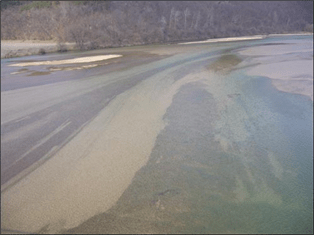
Sand flows with the river currents.
Originally, granite is a rock formed when magma cools under high pressure underground. The Korean peninsula’s terrain was shaped as these rock layers gradually rose to the surface over hundreds of millions of years through orogenic movements in the Earth’s crust. During their ascent, these rocks underwent various forms of weathering and glaciation. Hard rocks survived to become granite mountains, while weak rocks crumbled into sand and washed away. That’s why Korea has many rocky mountains and its rivers are rich in sand.

Granite distribution area in South Korea.

Electron microscope photo of sand. Plagioclase and biotite has many pores and irregularities.
In sandy rivers, filtration and sedimentation occur simultaneously. The water-purifying effect of sand is evident from the fact that most water treatment plants in Korea use sand as an essential medium to filter suspended solids and micro-organisms. River water flows above the riverbed and seeps through layers of sand and gravel, where suspended organic matter is filtered and purified. Micro-organisms living on sand and gravel layers further aid water purification.
London’s water supply system pumped water from the Thames River. But the river became severely polluted in the 19th century. They constructed purification facilities by using sand as filtering device. Sand filtration became the beginning of modern water purification system.
In Germany, sand filtration reportedly removed even cholera bacteria. In 1893, although cholera spread in the area where water from the Elbe River was used for drinking, there was no cholera victim in downstream city of Altona where they supplied water purified by sand.
Amsterdam in the Netherlands, located downstream of the Rhine River, could not access clean river water. To address this problem, they built massive sand beds over which Rhine water was pumped and filtered. The scale of these sand beds is comparable to the size of Bundang (a large eastern district of Seoul). Sand filtration system was effective in filtering water pollutants everywhere.
Sand rivers: The reservoir of clean water
The water-purifying effect of sand is truly remarkable. Why are pollutants removed in coarse filtering media like sand? This is because micro-organisms multiply in the sand filtration system layer and eat up water pollutants. Experiments with sand filtration show that even natural fiber cloth, such as cotton, will be completely decomposed and disappear without trace after about two weeks. This is a case where biological purification works extremely effectively. In such an environment, even impurities like seed leaves of aquatic plants or livestock manure can be thoroughly decomposed.

Sand flows very slowly in Nakdong River.
If you stand ankle-deep on the riverbed, and look down at the transparent current, you can see the sand grains shifting little by little downstream. This movement may be slow, but unmistakable. Fine soil particles are swiftly carried all the way to the sea. The coarser sand and gravel which move slowly are suddenly swept downstream in time of heavy rain.
The sand layers and sandbars of the Nakdong River’s mainstream once served as natural ‘filters’ that purified turbid water. According to measurements taken before the Four Major Rivers project, the BOD (biochemical oxygen demand) level of Nakdong River rose to 3.3 ppm while passing through Gumi and Daegu. But by the time it reached Mulgeum, the lowest downstream point, BOD improved to 2.8 ppm. This improvement was thanks to the sand layers. Unfortunately these sand layers disappeared entirely by Four Major Rivers Project.
In large cities, river water or reservoir water is pumped up in huge quantities and purified. But in most medium and small-sized town, tap water comes from surface water collected from beneath the sand and gravel layers of the riverbed. Since this water is relatively clean, the purification process requires less chemicals and lower costs. In other words, the river’s sand layers are vast reservoir of clean water. For the people living nearby Nakdong River, the sand river is something to be safeguarded as dearly as life itself.
As rivers flow, they transport sediments to the sea and erode the surface of the land, transforming landscape. When rocks react with water, organisms, and air, they weather and break apart. This process forms soil comprised of particles of many sizes. When heavy rains wash mountain soils into rivers, coarse particles settle as gravel in fast currents. But fine particles remain suspended and travel far downstream. They are deposited as clay in floodplain or accumulate as tidal mud which become treasure of coastal ecosystem.
Rivers with beautiful granite-sand beaches like Korean rivers are rare in the world. Major rivers in Europe such as the Thames, Rhine, Seine, and Danube flow through regions rich in limestone and clay sedimentary rocks. These rivers hardly have sandy banks. The Yellow River in China flows through loess regions, always carrying a yellowish tint, and deposits heavy amount of silt. By contrast, the Nakdong River’s golden and silvery sands are treasures worthy of preservation in themselves.
We must hold Lee Myung-bak, who committed the ‘atrocity of the Four Major Rivers Project’, and those who continue to deceive the truth, harshly accountable.
Lee Myung-bak completely destroyed this valuable sandy river by dredging to maintain six-meters-deep river for a canal. Even Hirotake Imamoto, Emeritus Professor of Civil Engineering at Kyoto University, testified during his 2010 visit to Korea. “If the purpose was river management, I cannot understand such works. It looks like a canal project. From the perspective of river engineering, there is no purpose other than a canal plan that could explain the Four Major Rivers Project.”
The Four Major Rivers project was far from preventing floods. On the contrary, it has been proven to cause flood hazard. Kim Jeong-uk, Emeritus Professor of Environmental Engineering at Seoul National University, explains: “To prevent floods, it is common sense to build dams or weirs upstream of river where damage is likely. But in the Four Major Rivers Project, they built weir structures downstream, raising the water level. And they claimed that the purpose of this project was flood-prevention. This kind of logic was unheard throughout history. During the record monsoon rains of 2020, flood damage in the Yeongsan River basin was caused by weirs which raised water level and obstructed flow. Whenever heavy rain occurs, the weir structures of Four Major Rivers Project turn into lethal weapons.”
The Four Major Rivers Project was not merely enforced, but became ‘massacre’ against nature. The film ‘Pursuit’ reminds us again of the roots of Lee Myung-bak’s atrocities. The results, as depicted in the movie, are widespread algal blooms and massive fish deaths. Our very lives are being destroyed. We must urgently proceed with river re-naturalization. At the same time, we must harshly hold accountable for the media and officials those who supported the destruction and deceived the public. We have to leave behind the lessons of history.
Translated by LEE Sang-Hoon
Original article is written by LEE Won-Young, 2025-08-11
https://www.mindlenews.com/news/articleView.html?idxno=15034
Categories: Uncategorized
 New Silk Road for Life and No-Nukes
Leave a comment