Lee Won-young, Director of the National Future Research Institute
Economy is not affected even if nuclear power plants are shut down
We must accelerate the transition to solar power to prevent risks
The new government must secure not only ‘safety’ but also ‘peace of mind’

‘Tung…’ ‘Tung…’
This is the loud metallic sound that can be heard when the boiler is turned on in the winter. The cold metal has been condensed for a long time, and then suddenly expands and bursts when hot heat enters. The condensed force is called ‘stress’.
The Nankai Trough, which Japan is currently afraid of, operates on a similar principle. It is a pattern in which energy is gradually accumulated and then suddenly released when it reaches a critical point. The Nankai Trough, which stretches from the coast of Tokyo to Kyushu, is at risk of a massive earthquake that occurs every 100 years. The longer the quiet period, the greater the shaking.
What we must also seriously consider is that a chain of earthquakes could occur near the Korean Peninsula as a result of that large earthquake. All of the nuclear power plants along the southeastern coast, including Gori, Shin-Kori, Wolseong, and Hanul, could be at risk of unexpected danger. If even a small accident occurs anywhere and radiation leaks, we will inevitably suffer a huge blow. The southeastern coast is densely populated and major industries and economic activities are concentrated there.
Think about the emergency that was declared three years ago when a radiation leak occurred at the Taishan Nuclear Power Plant in Guangdong Province, China. It could have been a fatal disaster for the population and industry in that region. Furthermore, in Korea, the Yoon Seok-yeol administration openly shouted, “Ignore safety.” After three anxious years, a new government will soon be inaugurated. And the new government has things to do first.
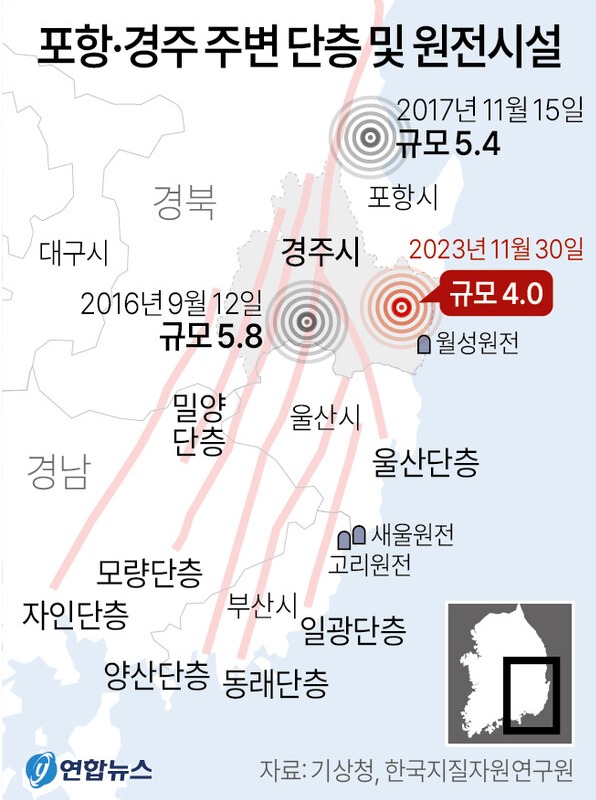
Nuclear power plant risks, must be thoroughly inspected and maintained
Above all, it is a detailed check and maintenance that completely prevents nuclear power plant risks. Currently, preventing risks by turning a blind eye to each other’s needs is not free from confirmation bias. Cross-monitoring is essential to ensure safety. Independent groups of engineers or other sovereign organizations, as in Europe as well as the United States, are essential for monitoring procedures. It is like a ‘monk cannot cut his own hair.’ To do so, most nuclear power plants must be shut down and inspected thoroughly.
This is the problem. Will there be any problems with power supply even if a significant number of nuclear power plants that need to be inspected are shut down? Japan has already provided the answer to this question. Immediately after the Fukushima accident in 2011, all 52 nuclear power plants were shut down for three years and safety inspections were conducted, but in reality, there were no problems with power supply. This was because gas power generation was used to supplement the cost, but it did not have any negative effects on the economy. In fact, you can see this by looking at the Japanese statistics on the shutdown of nuclear power plants at that time.

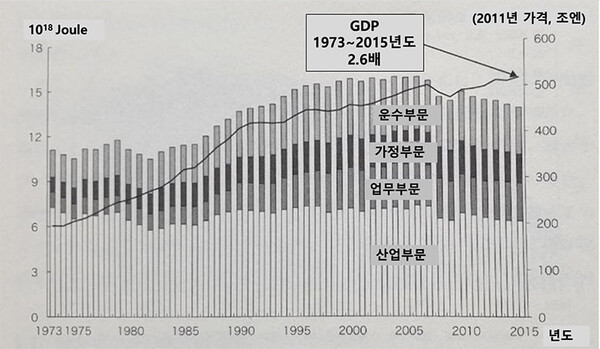
So even though many of them had stopped operating 10 years ago, there was no problem in reality. Battery technology that complements solar power has advanced by leaps and bounds in the meantime, and it seems that they are not relying much on gas power plants.
Nuclear power plants have already become much more expensive. The levelized cost of electricity (LCOE, the average cost required to produce 1 kWh of electricity considering all costs over the life cycle of a power generation facility) is about three times that of solar power. As solar power became the base power, nuclear power plants became disadvantageous for power system operation. Nuclear power plants became ugly ducklings that could not be operated even if they were increased. The small modular reactor (SMR) that the nuclear power industry is pinning its hopes on is being ignored even in the United States. It has not yet left the laboratory and is still producing a lot of nuclear waste. It is still like an ‘apartment without a bathroom.’
If we leave this situation alone, something like the recent Nail House incident will happen. Even though the Yoon Seok-yeol administration has come to an end, zombie-like bills have been proposed. These are ‘nuclear power plant-related bills’ such as the ‘Special Act on Supporting the Nuclear Power Industry’ and the ‘Act on Activating Support for Nuclear Power Plant Exports.’ They even proposed exemption from preliminary feasibility studies and deregulation for SMRs that have not even been verified. However, nuclear power plant exports were actually a detonator for fiscal risks that had to be covered by taxpayers’ money. The gimmicky bills were an attempt to seal that failure with legislation.
Some argue that Korea has an advantage in the construction of research reactors in the global market recently, so we should support them. However, this is closer to the scientific realm of making radioisotopes, not the realm of the nuclear power industry that produces electricity. Nuclear waste is also 1/1000th of that of nuclear power plants. Nuclear power plants are no different from factories that mass-produce nuclear waste under the pretext of producing electricity, so there is a fundamental difference between them.
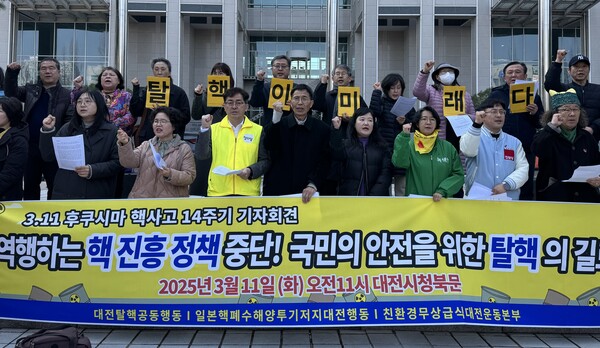
Climate measures with solar energy
Meanwhile, last summer, when the candlelight protests on the asphalt were in full swing, the Constitutional Court made another important ruling. It was a ruling on the ‘climate lawsuit’. It ruled that the ‘Carbon Neutral Plan Act’ lacking a plan for 2031-2050′ was unconstitutional and stated, “Revise it by the end of February 2026.” Climate crisis response is impossible without energy transition. Therefore, a blueprint for it is required.
Climate measures have no choice but to focus on solar energy, even considering the RE100 export economy. Recently, some have mentioned nuclear power plants under the pretext of AI power demand. However, let’s look at the United States.
The US Department of Energy (DOE) predicts that data center power consumption, including AI, will more than double by 2030, but solar power has been chosen as the main energy source instead of nuclear power. The reason is that building a new nuclear power plant costs 35 billion dollars (about 50 trillion won, Vogel Nuclear Power Plant in Georgia) over 10 to 15 years, and it is difficult to promote due to opposition from local residents and nuclear waste issues. On the other hand, solar power can be installed quickly, and its production cost per 1MWh is 30 to 40 dollars, which is 1/4 of that of nuclear power (about 160 dollars), and it can be expanded nationwide with rooftop solar power, and there are areas with abundant sunlight such as Texas and California.
Jeju Island in Korea has also been dazzling recently. “Jeju Special Self-Governing Province achieved temporary RE100 on April 14, the first in the country to meet 100% of the province’s electricity usage with renewable energy. From 11 a.m. to 3 p.m. that day, it produced and supplied only renewable energy sources such as wind and solar energy for 4 hours. In addition, surplus electricity exceeding the province’s consumption was transmitted to the mainland via the submarine linkage. The submarine linkage (HVDC) connecting Jeju and the mainland has a two-way transmission function that can transmit up to 180 MW per hour, which can contribute to resolving the problem of oversupply of renewable energy.”
It’s an amazing story. If Jeju can do it, there’s no reason why the whole of South Korea can’t. All you need is enough battery equipment, and with V2G technology, electric vehicles can be used as batteries. It’s just a matter of time. If the new government puts its mind to it, there’s nothing it can’t do.
There’s also another piece of good news. “In 2023, residents of Saokdo, Sinan-gun, received 16.92 million won per household in dividends from solar power generation.” This is an unprecedented event. Sitting still and earning income. This one example suggests many things to us. 1) It refers to recent trends, 2) It happened in a fishing village, 3) It is a clean energy source called solar energy, and 4) It is a considerable amount of money. Since it is linked to basic income, we can find sufficient alternatives here.

It is dereliction of duty to ignore the path to improvement. The future is not something to be predicted, but something to be created. It will continue to be created after 2031. There is no reason to be dragged around by dangerous and inadequate nuclear power plants forever.
We can no longer delay it. This is the time when the insurrection regime that defended the energy hegemony of vested interests has come to an end. And with the new president only 40 days away, we must make a decision. We must think carefully about policies and guidelines that he can immediately implement.
The new government must be able to secure not only the safety of citizens, but also their peace of mind. Even for the mental health of the residents who live as if they are carrying nuclear landmines on their heads…
Write; Lee Won-young,
leewysu@gmail.com
Director of the National Future Research Institute
Translated by Cha Yun-hwa
Original text; Mindlenews 2024-04-20 (Korean)
https://www.mindlenews.com/news/articleView.html?idxno=13053
Categories: Uncategorized
 New Silk Road for Life and No-Nukes
Leave a comment