GLOMA concept From fall 2024
After the US October March, the GLObal citizen’s MArch Future Program
We regularly hold the Stop Nuclear Wastewater Dumping March by inviting citizens from around the world who are staying in Korea.
First Saturday of every month, 1:30 PM to 3:00 PM
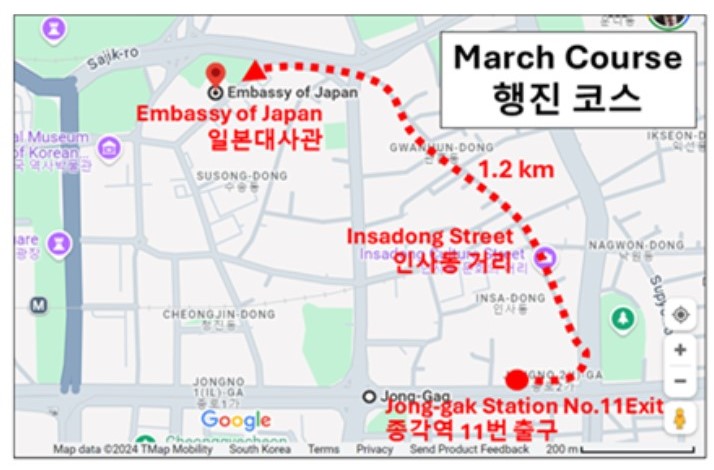
March route>
Jonggak Station Exit 11~Insa-dong Entrance Yard~Insa-dong March~Anguk Station Yard~Japanese Embassy,
(approximately 1km)
<March schedule>
2024
November 2nd French, German, andAmerican-led March
December 7th World Citizen March
2025
January 4th World Citizen March
February 1st World Citizen March
March 8th 3.11 Fukushima 14th Anniversary Event
April 5th World Citizen March
May 3rd World Citizen March

Announcing the Insadong Global Citizens’ March to ‘Stop Nuclear Wastewater Dumping’
= We have ‘antagonistic power’, we will push for regular marches =
Lee Won-young,
the former professor at Suwon University,
head of the GLOMA (Global Citizens’ March to Stop Nuclear Wastewater)
leewysu@gmail.com
If all nuclear power plants were shut down, would power supply be possible? After the Fukushima accident in 2011, the Japanese government shut down all 54 nuclear power plants that had been supplying 30% of the country’s electricity for three years. This was for safety inspections. We also need to consider such a situation. If it is determined that defective nuclear power plant components pose a serious risk on site, or if we consider the threat of drone attacks in wartime, there is no way such a situation could not occur.
Even if all nuclear power plants are shut down, there is no problem with power supply
Here is the answer to my question from Engineer Kim Dae-kyung (Consultant at the Asian Development Bank, former Senior Researcher at the Korea Electrotechnology Research Institute). “Even in the extreme situation where all nuclear power plants are shut down, considering the current status of power generation facilities in Korea, there is a high possibility that there will not be a major problem in the short-term power supply. This is because there are sufficient power generation facilities to fill the nuclear power vacuum.” He said, “In 2023, the national power generation capacity will reach approximately 144.4 GW, of which nuclear power generation will account for 24.65 GW, or approximately 17%. Even if all nuclear power plants are shut down, this vacuum can be filled through LNG (43.3 GW), coal (39.2 GW), renewable energy, and other power sources (31.8 GW). In the short term, by operating all of the 119.77 GW of power generation facilities, we can sufficiently meet the maximum power demand of 91.56 GW.”
Of course, solar and wind power are sensitive to climate conditions, but even considering that, if LNG and coal-fired power plants are operated at full capacity, a reserve rate of 6-10% can be maintained. In addition, emergency private generators installed in industries, hospitals, and large commercial facilities have a power generation capacity of about 34 GW, so emergency generators can play a supporting role during peak hours when nuclear power plants are shut down. In fact, during the three years when all nuclear power plants were shut down, the Japanese economy did not shrink at all. A world without nuclear power generation has arrived.
In addition, nuclear power plants are a source of heat pollution in themselves, and their massive warm water discharge threatens the marine ecosystem while also negatively affecting carbon storage. And they are bound to be in an antagonistic relationship with solar energy, which is supposed to solve the climate crisis, in terms of power grid operation. They are the main cause of worsening climate problems. We must now think from the beginning.

National Sovereignty Ignored
Originally, decision-making on hazardous facilities such as nuclear power plants was subject to national sovereignty. However, the nations of the world have ignored this. The risk of a nuclear power plant accident threatens the safety of all citizens, and nuclear waste is something that forces sacrifice on future generations.
Common sense tells us that a single-term government has no authority to pursue this. Nevertheless, even in countries where democracy is established, there have been few instances of citizens being asked for consent. In principle, this is a serious violation of national sovereignty. Japan is no different. The current illegal dumping of nuclear wastewater is a matter for which the people are directly responsible, but it is being completely ignored. It is a destruction of democracy.
Citizens from Korea and Japan (GLOMA, Global Citizens’ March to Stop Nuclear Wastewater), who have been consistently opposing the plan since last year, read the following statement together with Korean-Americans at the White House in Washington, D.C. two weeks ago.
GLOMA Statement in Front of the White House, USA (2024-10-7)
The Japanese government has continuously dumped the messy nuclear wastewater from their melted down reactors into the ocean, the mother of all life, not to mention that their ocean dumping is still ongoing at this very moment. They have already dumped over 60,000 tons on eight occasions. However, unlike Japan, the state governments of Massachusetts and New York last summer banned the dumping of even the smallest amount of radioactivity contained in the contaminated water used to cool their nuclear power plants. Furthermore, the Chinese government has completely banned the import of Japanese seafood. Yet the U.S. federal government is taking a completely different path. What on earth is going on?
If we do not say that the bad deeds are wrong when we witness them, we will eventually face a real crisis. The Japanese government’s actions seem to destroy even our spirits. The US federal government, which tolerates the Japanese government’s atrocities, confuses us.
We must protest this and hold them accountable. Last summer, we protested with Korean and Japanese citizens by walking 1,600 kilometers from Seoul to Tokyo. This year, we marched in Kyoto and Osaka, and in July, we marched to the UN in New York, delivering Global Citizen Declaration. Then, we passed through LA and now we have reached Washington, D.C.
Today, let us walk 1.8 miles through downtown Washington, D.C. to the White House to deliver our powerful message as American citizens! Let’s protest and march with all our might!
Finally, let’s chant our slogan together.
STOP DUMPING NUCLEAR WASTEWATER!
A march is held in Insa-dong every first Saturday of every month.
Meanwhile, Seoul is already an international city. There are many people from all over the world who are staying there for a long time. In May and June, I received signatures from many citizens of the world for the Stop Nuclear Wastewater Dumping Movement in Insa-dong. So from now on, I plan to regularly perform against the tyranny of unjust state power in Seoul.
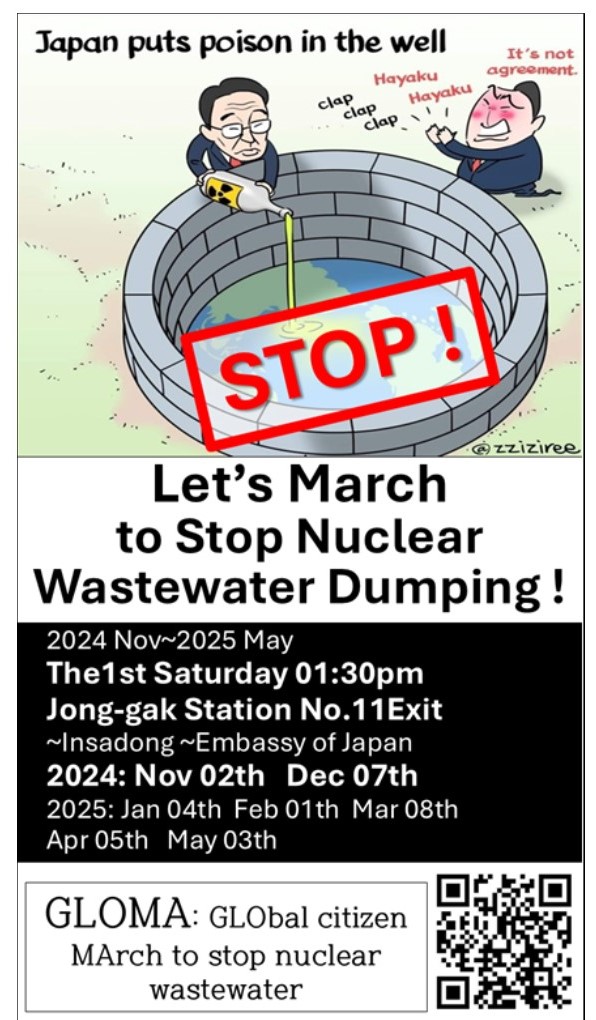
It is a march through Insadong Street on the first Saturday of every month from 1:30 PM to 3:00 PM, where citizens around the world come together to chant “Stop Nuclear Wastewater Dumping.” The first march is on Saturday, November 2, and the next one is on Saturday, December 7. Moving into 2025, the marches will be on January 4, February 1, March 8, April 5, and May 3.

The GLOMA March Course runs every first Saturday of the month from 1:30 PM. The first march is on November 2nd.
The gathering place is in front of Exit 11 of Jonggak Station on Line 1. We will walk along Insadong Street, shouting out messages, and after walking 1.2 km, we will arrive in front of the Japanese Embassy, where we will have a free speech. Any citizen of the world can participate.
We have the power to stop evil. As this year’s Nobel Prize winners in economics say in their book Power & Progress, the people have “antagonistic power.” It is the power to fight against evil and fight against evil. That power is what sustains democracy. However, power is not enough to exist. It is complete power when it is properly exercised.
GLOMA 구상 2024년 가을부터
미국10월행진후 세계시민행진 향후프로그램
한국체류중인 세계각국시민을 초청하여 핵폐수투기STOP행진을 정기적으로 진행합니다.
매월 첫째 토요일 오후 1시 반~3시까지
<행진 노선>
종각역 11번 출구~인사동 입구 마당~인사동 행진~안국역 마당~일본대사관
(약 1km)
<행진 일정>
2024년
11월2일 프랑스 독일 미국인 주축 행진
12월7일 세계시민행진
2025년
1월4일 세계시민행진
2월1일 세계시민행진
3월8일 3.11후쿠시마 14주기행사
4월5일 세계시민행진
5월3일 세계시민행진
Categories: Uncategorized
 New Silk Road for Life and No-Nukes
Leave a comment