Home Special Feature Lee Won-young’s LifeNoNukes Peace Movement
[Walking 1,600 km to oppose the discharge of contaminated water from Fukushima] 1. What was delivered to the Japanese National Assembly
The beginning of a series of records of the Korea-Japan citizen march to stop the discharge of nuclear waste water.
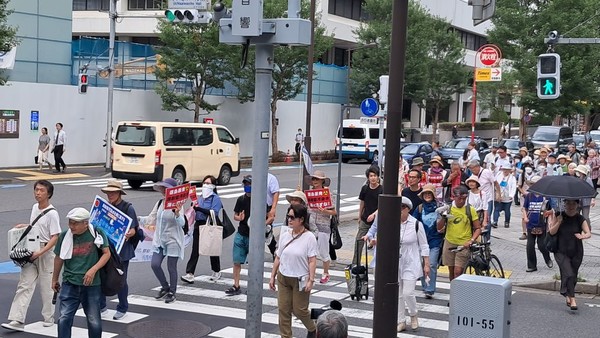
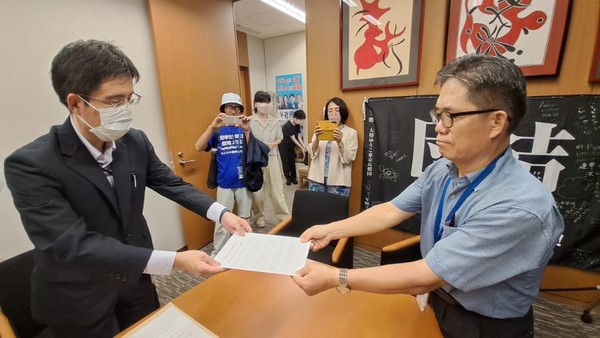
At last, we entered the conference room where the staff of the House of Representatives Secretariat of the Japanese National Assembly was waiting. The handover ceremony was held in the office of Yuko Otsubaki, deputy leader of the Social Democratic Party and member of the House of Councilors, in her presence. It was the moment when the 86-day, 1,600km journey between Korea and Japan came to an end.


Yasuo Kuwano began reading the petition in Japanese. Below is a translation of the original text into English.

September 11, 2023
To Hiroyuki Hosoda, Speaker of the House of Representatives
Petition requesting deliberation by the National Assembly on the ‘contaminated water’ issue at Tokyo Electric Power Company’s Fukushima Daiichi Nuclear Power Plant and suspension of discharge of contaminated water
Petitioner: Yasuo Kuwano and 4 others (Wonyoung Lee, Kiyoko Mito, Shorin Kihara, Masahide Kimura) (address omitted)
Ⅰ. Petition main points
The Kishida Cabinet decided on August 22nd to release “treated water” from Tokyo Electric Power Company’s Fukushima Daiichi Nuclear Power Plant, and discharge began on the 24th. Since then, this has caused great backlash and anxiety both at home and abroad, and has become a serious problem that is expected to lead to an irreversible situation if it continues like this. The Kishida Cabinet broke its promise to the National Fisheries Association, which represents Japanese fishermen, to “not implement the policy without the understanding of fishermen.” This is the government unilaterally breaking trust with the people, who are the owners of the country.
The impact of tritium in the ‘treated water’ discharged on the natural marine ecosystem is causing anxiety and backlash at home and abroad. In addition, it is said that there are not only 62 types of radioactive contaminated water that have melted down, but more than 200 types, and it also contains extremely dangerous nuclides. This is against the principle of containing and managing radioactive contaminants, raising scientific questions about the future damage to the natural ecosystem and the serious impact on the future of humanity.
Also, consent from neighboring countries was not obtained. Put yourself in other people’s shoes. If a nuclear power plant in a nearby country has a meltdown and radioactive contaminated water in tanks is discharged into the Sea of Japan or the East China Sea, as in Fukushima, Japan will not tolerate it. Japan will require onshore storage. So it is natural that people in neighboring countries are protesting these days.
On July 26 of this year, the US state of Massachusetts rejected an application to release radioactive water from the Pilgrim Nuclear Power Plant decommissioning project into the ocean. Also, on August 18, Governor Hockle of New York State signed a bill prohibiting the discharge of radioactive materials from closed nuclear power plants into the Hudson River, and this bill was passed. Even in the Three Mile Island nuclear power plant accident in 1979 and the Chernobyl accident in 1986, radioactive contaminated water that came into contact with melted debris was stored on land rather than discharged into the sea or river. Japan’s ‘treated water’ is the first ocean discharge unprecedented in human history.
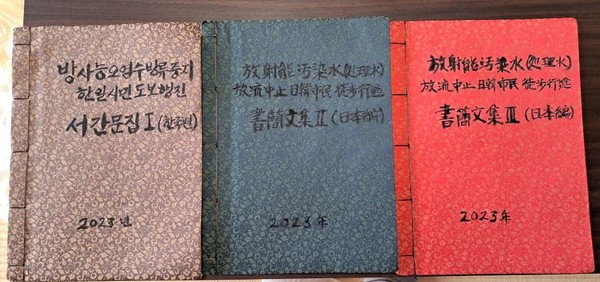
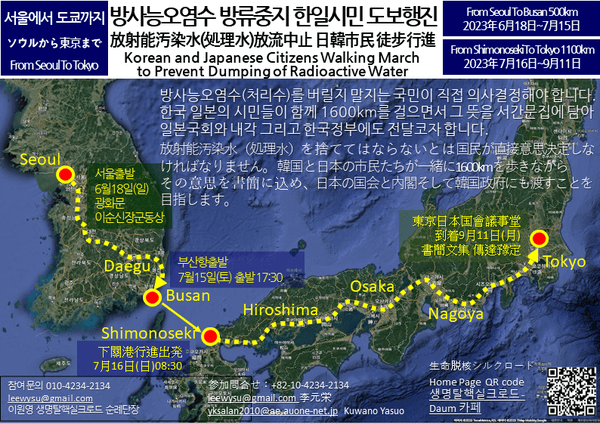
More than 80% of the Korean people are opposed to the discharge of nuclear polluted water, and one of them is Wonyoung Lee (Director of the National Institute for Land and Future Research, former professor of Urban Engineering at Suwon University). He, together with the Japanese people, has been pushing for this walking march, with the goal of leaving Seoul on June 18 and arriving at the Tokyo National Assembly on September 11, demanding a stop to the discharge of nuclear polluted water. The appeals of the people of the two countries who met along the march demanding an end to the discharge of nuclear polluted water were written in Japanese ink on Korean paper with a lifespan of 1,000 years, and he compiled them into a collection of letters. Pictures of people from all over the country cooperating with Mr. Lee are posted every day on his blog. Through this 1,600 km, 86-day walking march, we can see how much the people of both countries are opposed to the release of nuclear pollutants.
The government claims there was IAEA understanding. However, as shown on pages 18-19 of the IAEA Comprehensive Report, the ‘decommissioning justification’, which asks whether this release complies with the basic principle of ‘justification’ that ‘the benefits of release exceed the damage,’ has not been proven. The recent decisions of the two states in the United States mentioned above are also an ethical request for the survival of humanity that radioactive contaminated water should not be discharged into the sea.
Also, the people of Hiroshima and Nagasaki suffered damage from nuclear war and suffered nuclear damage from radioactive substances contained in black rain. In addition, Minamata disease patients are victims of bioaccumulation in the food chain caused by organic mercury marine pollution by Chiso Corporation, and the cause and mechanism are known. On December 12 last year, 100 National Oceanographic Research Institutes (NAML) gathered to discuss what kind of genetic impact radiation exposure to all living things will have on humanity. And the National Association of Marine Laboratories (NAML) released a statement titled ‘Scientific Opposition to Japan’s Discharge of Radioactive Contaminated Water’.
On May 14 of this year, the International Physicians for the Prevention of Nuclear War (IPPNW), an organization that has won the Nobel Peace Prize (1985), issued the following statement at its board of directors: They called for an end to plans to use the Pacific Ocean as a dumping ground for radioactive waste and to pursue alternatives that protect the ocean and human health. In this way, we are trying to set a direction for what humanity should do about the environmental impacts of radioactive contamination, ethically, scientifically, and historically. Should such a big issue have been decided solely by the Cabinet meeting on August 22nd?
In matters such as these, a democratic country must provide its sovereign citizens with information about the content and impact and decide from the beginning through a national referendum. If we do not have that system in place now, it is something that needs to be decided after the National Assembly discussions are made public. Western countries and even Taiwan use referendums to decide on important issues that can affect even the distant future of humanity. The method of making decisions solely through the decisions of the State Council without discussion in the National Assembly is not a democracy but a dictatorship. As sovereigns of a democratic country, we demand the following from the Speaker of the House of Representatives:
Ⅱ. Petition Matters
1.The National Assembly should urgently conduct an out-of-session review regarding the discharge of ‘treated water’.
2.There is scientific concern that the release of ‘treated water’ could have an irreversible negative impact on life that could even affect humanity in the distant future. The ocean discharge of humanity’s first radioactive debris pollutants conducted by the government and Tokyo Electric Power Company must be stopped.
Mr. Won-young Lee submits a collection of letters urging to stop the discharge of contaminated water written by citizens of both countries whom he met along the Korean-Japanese walking march along with the petition.
(Japanese original text is https://cafe.daum.net/earthlifesilkroad/kUxW/136)
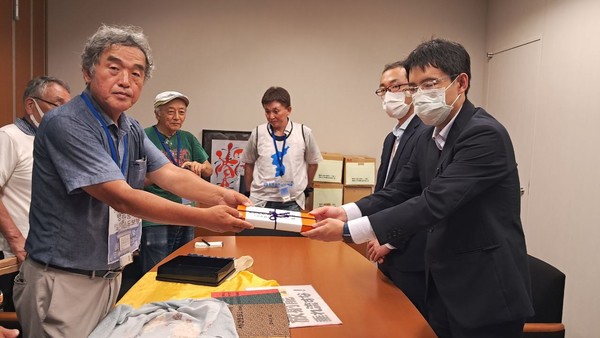
Next, as the leader of the marching group, I also delivered a USB containing a collection of messages from 86 Korean and Japanese citizens. Originally, if I met the representative of the House of Representatives in person, I was planning to deliver the original collection of letters to him. However, in the end, it was a member of the National Assembly who received it instead of him, so I delivered the USB instead of the original letter book.
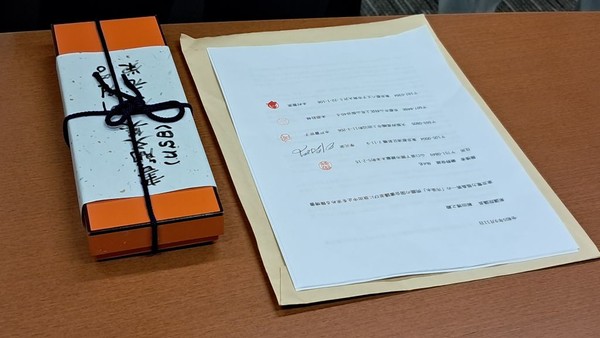
Next, Kuwano-Sang read the Korean Citizen’s Declaration, which was brought by Korean citizen Comrade Jeong Young-hoon (co-representative of the Candlelight Revolution Completion Solidarity). He translated the names of the Korean and Japanese civic groups that participated in the declaration into Japanese and read them out loud. There were so many that it took more than 10 minutes just to read all the group names. This content and the names of participating organizations are included in the linked article below.
Article by Younghoon Jeong, including the Korean Citizen’s Declaration
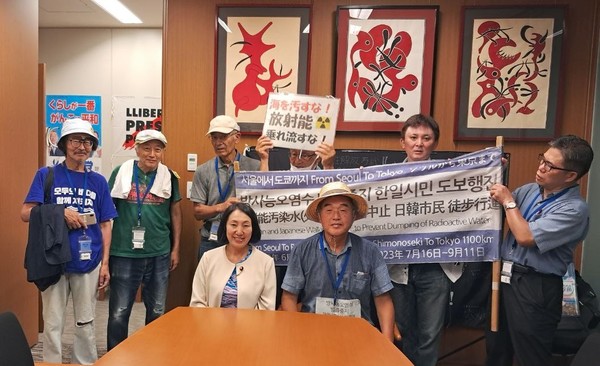
Looking back, the 86 days between Korea and Japan were not a short journey. The march walked 10 km each morning and evening to avoid the midday heat. There are many stories because it was a step taken by many people with the same goal. There are also photos of each moment and location of the march. I want to compile all of this and leave it as a record.
Original Article >> http://www.hanion.co.kr/news/articleView.html?idxno=29713
Editing: Editor Mi-kyung Kim, Editor-in-Chief Dong-ho Kim
Shareholder Wonyoung Lee leewysu@gmail.com
(translated by Yoonhwa Cha)
Categories: Korean-Japanese citizen walking march
 New Silk Road for Life and No-Nukes
Leave a comment